Data center water leakage programs were built around raised-floor piping and CRAH units, not the cooling loop running through the rack. Direct liquid cooling and CDUs put leak points inside the rack, past where under-floor rope sensors are positioned to…
ASHRAE’s recommended envelope, 18 to 27 degrees Celsius, applies at the equipment air intake, not the room average. Allowable ranges widen from Class A1 to A4, so the ‘right’ upper limit depends on what hardware the room runs. Most facilities…
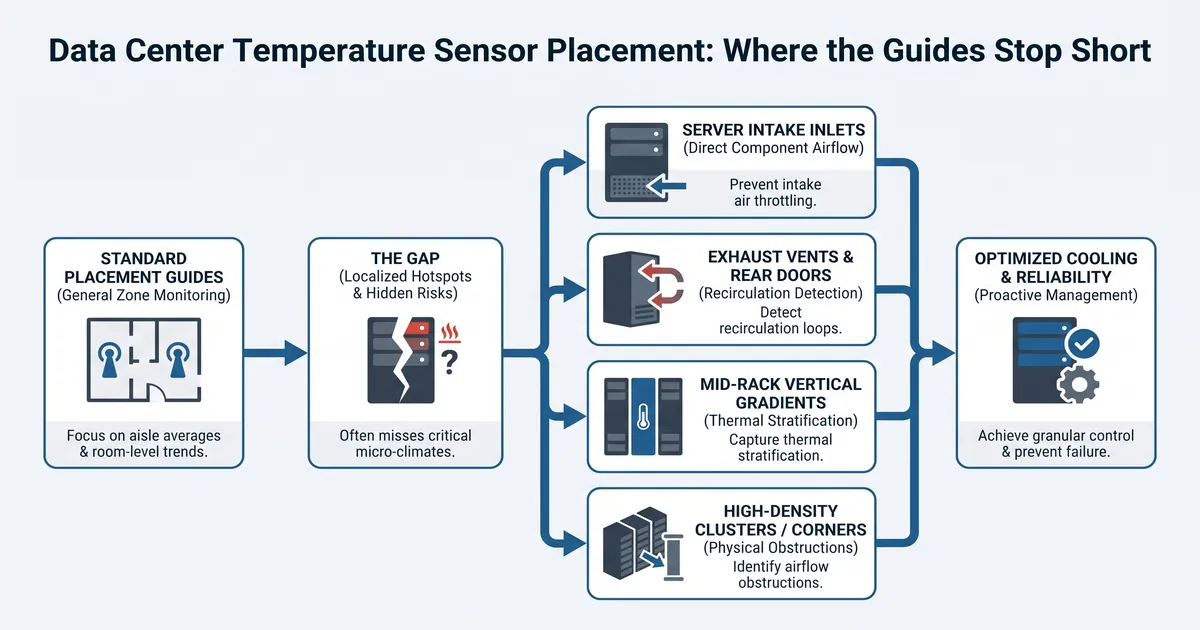
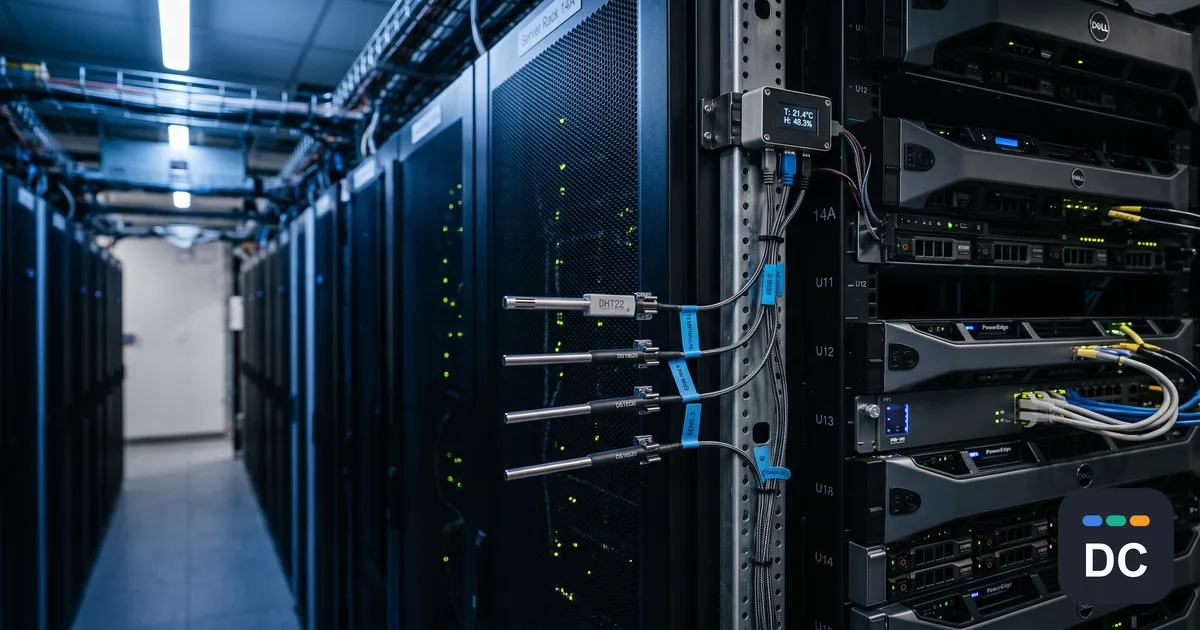
ASHRAE-based placement guidance is consistent on sensor counts and rack positions, but almost no published guide addresses what happens after installation. Calibration drift and single-point sensor failure are the two most common ways a correctly placed sensor grid quietly stops…
Environmental monitoring guides converge on the same sensor list and ASHRAE ranges, but rarely define what should happen once a reading crosses a threshold. Facility-wide static thresholds generate nuisance alerts that erode trust in the system faster than they catch…
A monitoring system can only detect events that are slower than its sampling interval, so the poll rate is the real capability spec. Capacity and thermal decisions get made on averages while breakers and IT equipment react to peaks the…
Global and national data center power consumption figures describe aggregate capacity or modeled totals, not what any single facility actually draws hour to hour. A facility’s nameplate power rating is a design ceiling; sustained draw typically runs well below it,…
N+1 redundancy for CRAH units is a capacity count, not a guarantee that airflow redistributes evenly after a failure. CRAH units depend on an upstream chilled-water plant, so a redundant air handler can still go idle if that supply is…
On-site and behind-the-meter power lets AI data centers skip multi-year grid interconnection queues, but it makes the operator responsible for generation reliability that used to sit with the utility. Coverage of the shift focuses on technology choice and site economics;…
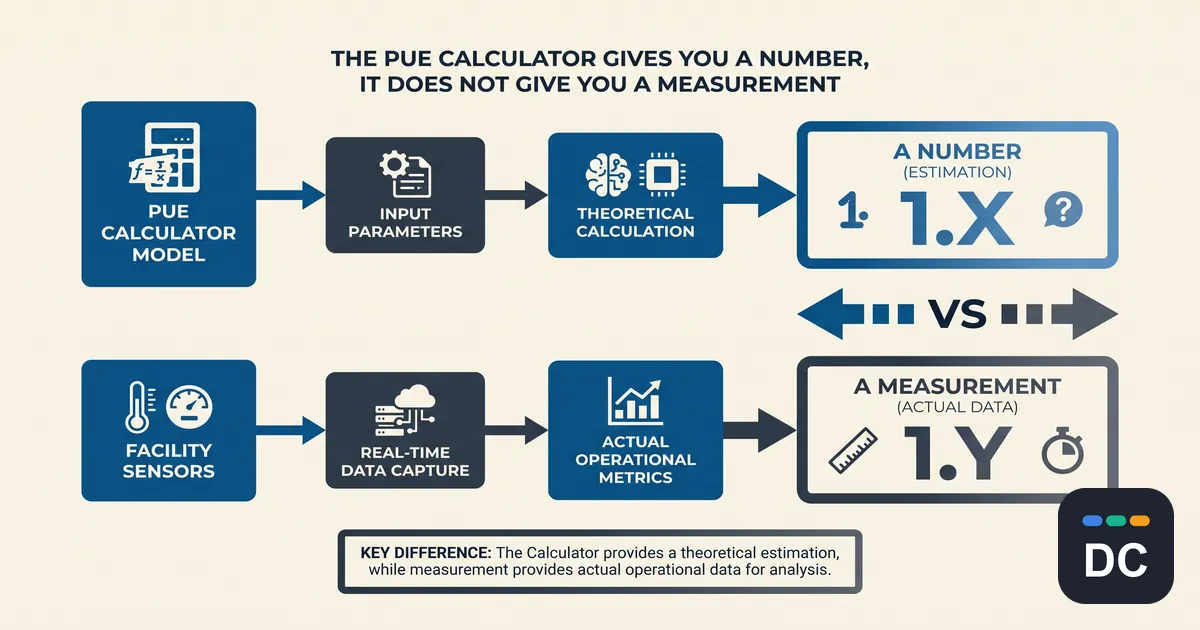
Summary: A PUE calculator does arithmetic; however, the math was never the hard part. Power usage effectiveness is a measurement protocol, but the conditions that protocol turns on are the three things no calculator asks: where you metered the IT…
AKCP carries the broadest catalog of networked sensors and is the only platform pairing cameras with real video AI. RF Code owns fully-wireless monitoring (active RFID, 5-yr battery); most others are wired or wired-first. Power monitoring is split — AKCP,…