Summary:
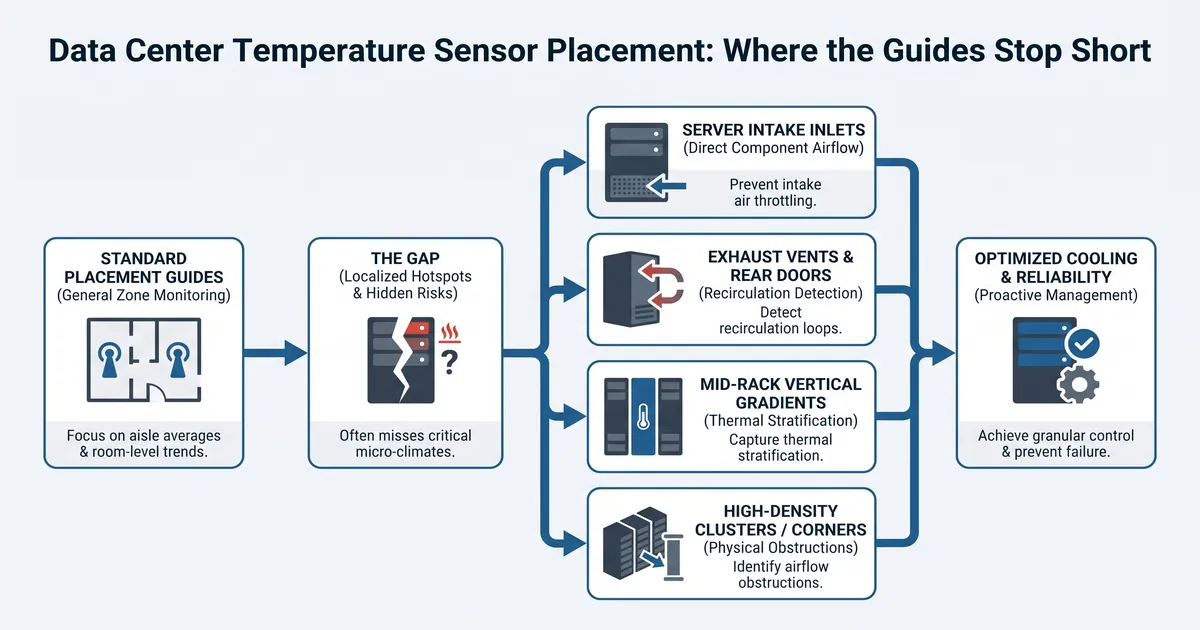
The standard guidance for data center temperature sensor placement is at the top, middle, and bottom on the front of each rack, and the front and rear of every 3rd or 4th rack. This follows ASHRAE TC9.9 recommendations. What these recommendations and guidelines don’t address is what happens when a thermistor has drifted out of calibration, or crosses a threshold that nobody has set.
Sensor placement has converged
ASHRAE’s TC9.9 committee recommends measuring at the center of rack air intakes, two inches in front of equipment, at top, middle, and bottom positions. For ongoing management rather than one-time verification, ASHRAE allows for less density with readings at every fourth rack position, about five feet above the floor, in cold aisle centers.
However, the second approach that ASHRAE recommends could be questionable. Reality shows that center-of-aisle readings alone miss hot spots and cold spots as well as producing more false-positive alerts. The general consensus has converged on a hybrid. Rack-level sensors at intake and exhaust for ∆T calculation, supplemented by fewer room-level sensors.
What “correctly placed” does not guarantee
Even a well thought out and planned temperature monitoring system can be problematic without attention being paid to what comes after deployment. Thermistors and RTDs drift with age and thermal cycling. A sensor reading 2°C warm or cool six months after commissioning will likely go unnoticed. The usual placement guidelines make no mention of baseline checks, their frequency, or recalibration cycles.
The result is a feeling of a false sense of security. A data center can meet ASHRAE guidance and still operate on incorrect temperature data if placement is the final thought rather than an ongoing operational requirement.
Redundancy: the space between installed and working
A less dense placement layout is fine, until it’s not. When a sensor fails from a wiring fault, power issue, or calibration drift, what happens? You have a gap in your monitoring that you may not even notice.
Current sensor placement guidance does not typically include redundancy. It is discussed, if at all, as a separate topic under “mission-critical monitoring”. For operators deploying sensors from placement guides, redundancy is often skipped altogether.
There are solutions that can help address this. AKCP has sensors such as their NIST2 and NIST3 sensors, which provide internal calibration checks and failover should a sensor fail or be out of calibration.
From a reading to an action
So, you have a well thought out sensor placement and redundancy strategy. What are you now doing with the data you are collecting? What are your alarm handling protocols, escalations, and data analysis methods? How do you interpret ∆T between intake and exhaust air temperatures?
This matters because a correctly placed sensor with no threshold behind it is simply insurance, a lagging indicator when something goes wrong. The Lawrence Berkeley National Laboratory thermal guidelines document ASHRAE recommended and allowable temperature and humidity envelopes. But how do you translate this into a working alert policy? That is left to operators with almost no published guidance. Make your thresholds too tight, and you suffer from alert fatigue; too loose and thermal events go unflagged until equipment is at risk.
Sophisticated DCIM software such as Quicklime DCIM, with AI analytical tools and sensor-backed Computational Fluid Dynamics, aims to address these issues by making sense of the data and providing actionable reports on what is going wrong and, more importantly, how to fix it.
The layout diagram is only the start
We are not arguing that ASHRAE’s rack-level and room-level recommendations are wrong. They are well-tested and worth following. The issue is that they stop short after placement in terms of how you actually utilize the data.
A data center monitoring plan needs four things. A calibration check schedule, redundancy at the sensor level for anything classified as mission-critical, documented alert thresholds tied to the facility’s allowable range rather than defaults, and a review cycle that identifies defective monitoring points.
Leave a comment