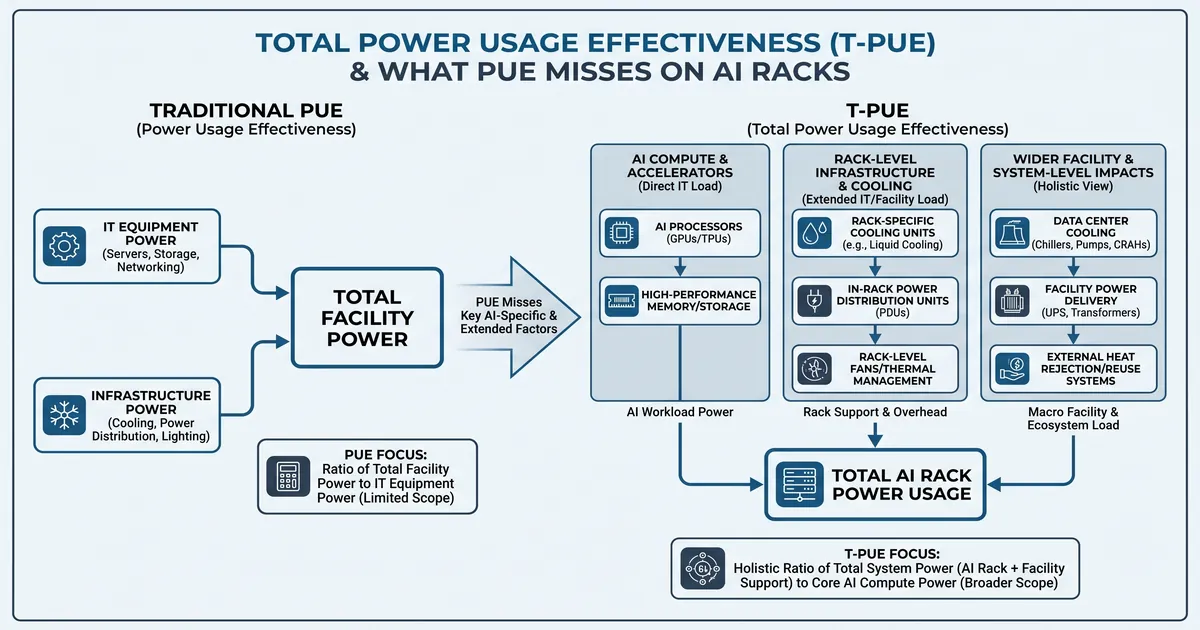
The short version: Total power usage effectiveness (TUE) exposes the dirty secret of high-density AI deployments. By multiplying facility PUE with IT power usage effectiveness (ITUE), it accounts for the massive energy lost to howling server fans, power supplies, and voltage regulators before a single electron hits the GPU die. Hyperscalers are adopting it because a pristine facility PUE often masks horrific inefficiencies stranded inside the rack.
The PUE Illusion
A facility with a 1.2 PUE sounds impressive. However, PUE measurement stops at the rack and assumes all power going to it does useful work. In reality, modern AI racks lose energy through AC-to-DC conversions, voltage step-downs, and aggressive cooling. A GPU drawing 700 watts demands heavy voltage regulation and fan-speed scaling that consume power regardless of actual compute load.
The Green Grid defined T-PUE back in 2010, and Oak Ridge National Laboratory later proved its real-world value in 2013 by applying it to supercomputing clusters. The formula, like PUE, is quite straightforward:
T-PUE = ITUE × PUE.
T-PUE isolates the ratio of power entering the server versus what actually reaches the silicon. Multiplying them gives you the true utility-to-processor cost. Modern liquid cooling loops and heavy GPU demands make internal conversion losses more relevant than ever.
Mapping the complete power train, with metrics at each power transition point, lets operators know exactly how much power reaches the IT footprint versus what gets lost in distribution. These tools are found in DCIM software such as AKCP’s Quicklime DCIM.
Managing Metering Blindspots
Calculating accurate ITUE requires readings most legacy facilities lack. PUE relies on rack-level metering and total facility loads. TUE requires a more granular measurement at the server input and as close to the GPU as possible.
You can manage metering better without approving massive capital expenditure. Using power management controllers that expose input power and fan speeds over common protocols lets you monitor them in your DCIM or BMS platform.
The Thermal Reality of Conversion Loss
Every watt lost to poor voltage regulation turns into heat. Heat drives higher fan speeds, resulting in a feedback loop that further degrades ITUE. Identify and manage these thermal losses to improve ITUE.
Post-commissioning drift often hides airflow problems that force server fans to work harder. Deploying AKCP Cabinet Thermal Map Sensors at the inlet and outlet of the top, middle, and bottom of the rack identifies these hot spots. Combined with sensorCFD analysis you can begin to optimize airflow for individual racks. If the servers are working harder than they should. Fixing the airflow directly drops fan power draw, immediately improving the ITUE.
Data Center Regulatory Shift
TUE remains an operational tool for now. Uptime Institute groups it with other emerging AI-era metrics rather than treating it as a direct PUE replacement. No ISO standard for TUE exists yet.
Governments are starting to look more closely at data centers with regulatory restrictions tightening. Germany’s Energy Efficiency Act (EnEfG), enacted in 2023, mandates continuous power and energy readings, with PUE targets taking effect in 2026. ITUE requires the same granular level of metering before it can become a daily metric. Get ahead of the curve and don’t wait for a formal mandate.
Start logging sustained server draw against rack PDU readings. When you need a true account of AI power costs, will your data show what the GPUs are actually consuming, or just what the facility is wasting?
Leave a comment