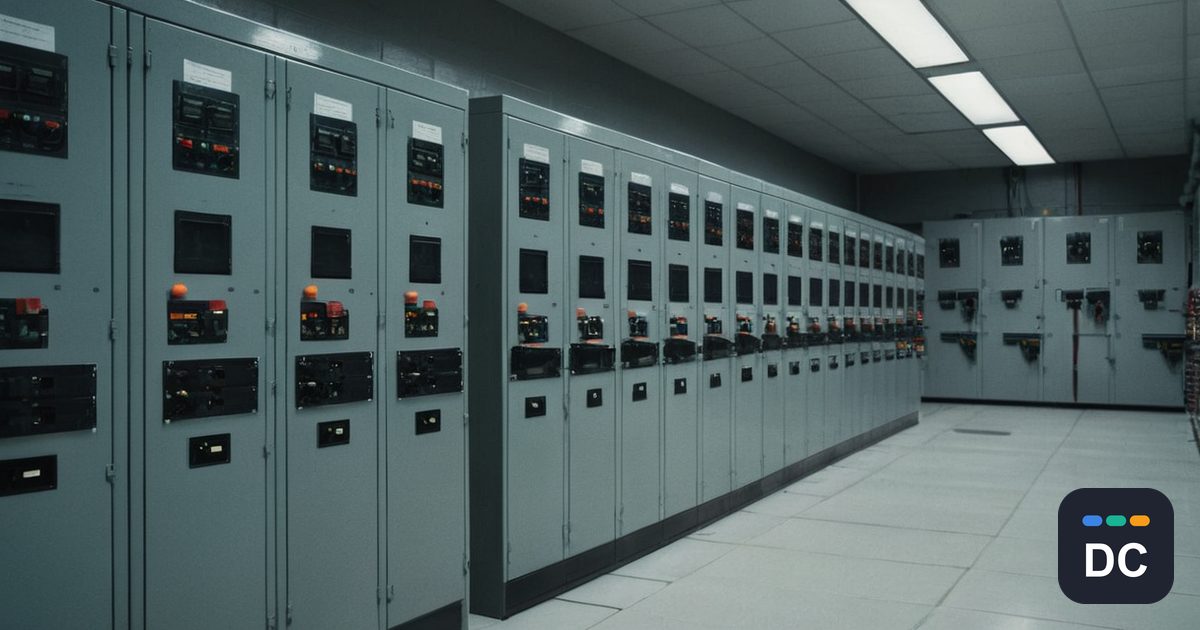
The floor looks full. Every position is allocated, the breakers are spoken for, the cooling is committed on paper. Then you walk the aisles with a clamp meter and the racks are drawing a fraction of what the design sheet says they would.
That gap has a name: stranded capacity. And the uncomfortable part is that most data centers said to be “at capacity” are not physically full at all — they are simply running inefficiently, carrying power and cooling headroom that is built, cooled, and financed but never used. It sits hidden behind worst-case assumptions. And you cannot reclaim it until you can measure it.
“Full” is usually a design artifact, not a physical limit
Capacity gets allocated during design, against a nameplate. A rack provisioned for a given load gets the circuit breakers, the cooling, and the floor space to match that number. In operation, the real parameters rarely come close to it. Design for worst case, then stack that worst case down the row, and you run out of design capacity long before you run out of real capacity.
Stranded capacity is exactly that gap — the distance between what you provisioned and what you actually draw. The hall reports full not because the physics says so, but because the spreadsheet does.
You can’t reclaim what you can’t measure
This is the part the usual capacity-planning advice skips. Reclaiming stranded capacity is treated as a modeling exercise — feed better numbers into the DCIM tool and the headroom appears. But the numbers are the problem. If your most granular power reading stops at the room or the PDU, every rack downstream carries a cushion sized by an assumption, not by data.
So the worst-case margin survives. Nobody is being careless; they simply can’t see below the level the meter reaches. The floor looks full, the meters say otherwise, and nobody can act on the gap because it was never measured at a resolution fine enough to trust. Resolution is the gate. Every rung you climb down the metering ladder — room, to PDU, to rack, to outlet — converts a guessed cushion into a measured one you can actually release.
Power headroom and thermal headroom — measured, not assumed
Closing the gap takes visibility on both sides of the capacity equation, because a rack is limited by whichever runs out first: electrical headroom or thermal headroom.
On the power side, a full Power Train model traces draw from the mainline down to the rack, with voltage, current, power, power factor, and kWh read at the individual outlet. Now you see real draw, not a label — and real draw is almost always well under the provisioned number.
On the thermal side, per-rack ΔT and live heat maps show how much cooling headroom a cabinet actually has, rather than assuming the whole row needs the margin you gave the hottest position in it. Real-time PUE ties the two together so the efficiency picture moves with the load instead of lagging a quarter behind it. Measure both, and the worst-case cushion stops being a guess.
Where the next rack actually fits
Measurement tells you the headroom exists. The harder question is where to spend it. Capacity AI reads that live picture — power draw and thermal headroom together — and recommends where your next rack, or even your next server, actually fits. The recommendation is measured against real power and thermal margin, not worst-case math carried forward from the design phase. That is the difference between an opinion about your floor and a fact about it: harness AI opinions with sensor facts.
The economics: every reclaimed kilowatt defers a build
Stranded capacity is the most expensive real estate you own — fully built, fully cooled, fully financed, and producing nothing. Reclaiming even part of it changes the capital conversation. The headroom you release is the next build-out you defer, the cooling unit you don’t yet buy, the additional floor you don’t yet lease.
That is the whole argument for measuring to the rack and the outlet instead of trusting the design sheet. One path optimizes against reality. The other manages a facility by worst-case assumption and pays to cool capacity it will never admit it has. The difference between them is resolution — and resolution is the cheapest capacity on the floor.