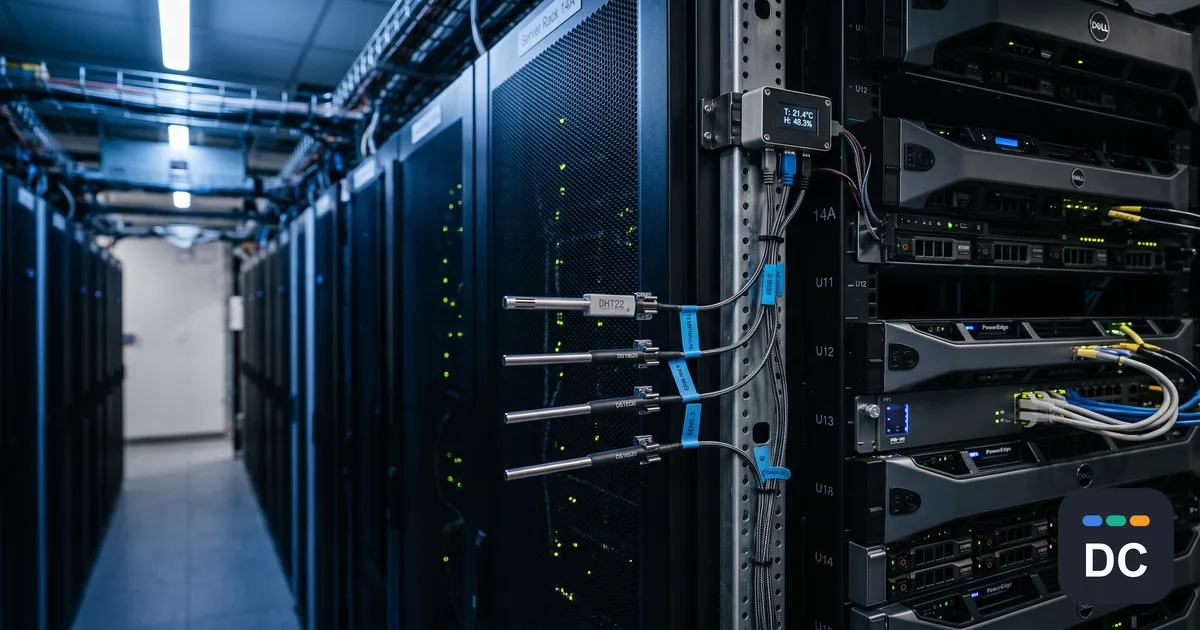
Choosing data center sensor monitoring is a question of breadth versus simplicity: how many things you need to watch (temperature, humidity, power, leaks, air quality, access, video) and how much intelligence you want on top of the readings. This guide compares seven environmental-monitoring platforms side by side.
Sensor monitoring platforms at a glance
| Platform | Deployment | Sensor breadth | Connectivity | Power monitoring | Cameras / video | AI / analytics | Integration |
|---|---|---|---|---|---|---|---|
| AKCP | On-prem units + software; AI runs locally | ~190 sensor types (environmental, power, air quality, leak, access) | Wired + wireless + LoRaWAN; PoE | ✓ Yes — V/A/kWh, per-outlet | ✓ Yes — video AI (object detection), unified | ✓ Deep — 4 AI modules + built-in LLM agent (local) | SNMP, Modbus, MQTT |
| HW group (HWg) | On-prem units + optional cloud | ~40/unit — temp, humidity, leak, smoke, power-fail, access | Mostly wired (1-Wire/RS-485); Ethernet/PoE/WiFi/cellular; no LoRaWAN | ✓ Yes — via M-Bus energy meters | ✕ No (IP cams via separate HSYCO add-on) | ✕ No — threshold alerts + logging | SNMP, Modbus TCP, MQTT, HTTP API |
| Raritan (Legrand) | On-prem controller; feeds BMS/DCIM | Up to 204 sensors — temp, humidity, airflow, pressure, leak, access, asset | Wired only (RJ-45 daisy-chain); no native wireless | ✕ No — via separate PX PDUs | ✕ No (optional USB webcam snapshots) | ✕ No — threshold; passes to DCIM | SNMP, Modbus, REST/Redfish |
| RF Code | On-prem or cloud (CenterScape) | ~7+ types — temp, humidity, leak, door, pressure, power | Fully wireless (active RFID, 5-yr battery, ≤1,400/reader) | ✓ Yes — PDU power tags + AC voltage | ✓ Yes — via separate Sentry device (IP + thermal) | ✕ No named AI (‘predictive’ marketing only) | SNMP, Modbus, MQTT, BACnet, REST |
| Schneider NetBotz (APC) | On-prem appliance; EcoStruxure-ready (cloud optional) | ~8 types (78 wired + 47 wireless) — temp, humidity, leak, smoke, vibration, door + access | Wired + native wireless; A-Link; built-in PoE for cameras | ✕ No — via separate APC PDUs | ✓ Yes — up to 4 HD cameras (motion clips; no AI) | ✕ No on-device (AI at EcoStruxure IT platform) | SNMP v1/v3, REST (Modbus/BACnet unverified) |
| ServersCheck (InfraSensing) | On-prem/edge (runs locally); optional cloud | 60+ types — temp, humidity, air quality/PM, leak (water/oil/fuel), power, vibration, smoke | Wired (RJ daisy-chain to 100m), PoE; WiFi/cellular add-on; no LoRaWAN | ✓ Yes — AC power fail/quality, current, DC (no kWh) | ~ Thermal-imaging sensor only (no CCTV/AI) | ✕ No — edge threshold analytics | SNMP, Modbus TCP/RTU, MQTT, JSON/XML |
| Vertiv Geist | On-prem appliance (Watchdog) | 4–16 — temp, humidity, dew point, airflow, door, leak, smoke | Wired (RJ12 daisy-chain), PoE on -P; no native wireless | ✕ No — separate Geist rPDU line | ✕ No | ✕ No — graphing + threshold alarms | SNMP v1/v2c, HTTP/JSON API (no Modbus/MQTT) |
Listed alphabetically, not ranked.
How to read the columns
- Sensor breadth Variety of sensors to choose from.
- Connectivity decides install cost. Wired daisy-chains are cheapest at scale; wireless (RF Code’s active RFID, or LoRaWAN) wins when running cable is the problem.
- Power monitoring: note how often it’s not in the environmental unit — several vendors meter power only in a separate rack-PDU line.
- Cameras / video are rare in this category, and AI on the video is rarer still — most cameras here only trigger on motion.
- AI / analytics: ask what the AI actually does. “Threshold alerts” isn’t AI; predictive/forecasting and a conversational agent are.
- Integration: SNMP is universal; Modbus/MQTT/BACnet/REST decide how cleanly it feeds your BMS or DCIM.
The platforms
AKCP. Wide variety of sensors and, on premise AI through Quicklime DCIM. Approximately 190 sensor types spanning environment, power, air quality, leak and access, with wired, wireless and LoRaWAN connectivity, real-time PUE, and video AI that runs on the same dashboard as the sensors. With 40+ years and 200,000+ facilities monitored, it suits teams that want one platform to cover everything and add intelligence on top.
HW group (HWg). Compact, affordable standalone units (Poseidon2, STE2) for straightforward multi-site temperature/humidity/leak/power monitoring; wired-centric, no cameras or AI. A good fit for simple, distributed sites.
Raritan (Legrand). A rack controller (Smart Rack Controller) that aggregates a high count of sensors (up to 204) and feeds a third-party BMS or DCIM; wired only, with power handled by Raritan’s PX PDUs. Strong contender if you already run Raritan power.
RF Code. Wireless specialist with patented active-RFID sensors. ~5-year battery life and no cabling, ideal for fast retrofit and hard-to-cable spaces. Narrower sensor range; cameras come via a separate Sentry device.
Schneider NetBotz (APC). An on-prem appliance strong on cameras and badged rack access, tying into EcoStruxure IT for analytics; ~8 sensor types, with power metered by separate APC PDUs. Natural choice if you run APC/Schneider equipment and software.
ServersCheck (InfraSensing). A broad open catalog (60+ types, including a thermal-imaging sensor) running locally at the edge; no conventional cameras or AI.
Vertiv Geist. Simple rack/room environmental monitors (Watchdog) for temperature, humidity and a handful of add-ons; wired, no power on the unit (that’s the Geist PDU line), no cameras or AI. A clean single-rack choice.
Where AKCP leads — and where a simpler tool fits
- AKCP leads when you want breadth + intelligence in one: the widest sensor catalogue, wired/wireless/LoRaWAN, power and environment together, and cameras with AI (not just motion), plus a real-time PUE and an on-prem AI assistant.
- A simpler or different tool fits when: you need a cable-free retrofit (RF Code), a cheap single-rack probe (Vertiv Geist or HW group), you’re already standardized on APC/Schneider racks (NetBotz) or Raritan PDUs (Raritan SRC). We’d rather tell you that than oversell.
Sensor monitoring — frequently asked questions
Which data center sensor monitoring has the most sensor types? AKCP (~190 types) carries the broadest catalogue; ServersCheck offers 60+, and Raritan supports a high sensor count (up to 204).
Which is fully wireless? RF Code (active-RFID, ~5-year battery). AKCP and Schneider NetBotz offer wireless options, and AKCP adds LoRaWAN; most others are wired-first.
Which includes cameras with AI? Only AKCP pairs cameras with video AI (object detection). Schneider NetBotz and RF Code (via Sentry) have cameras, but motion-triggered only — no AI analytics.
Which monitors power and environment together? AKCP, ServersCheck, HW group and RF Code monitor power alongside environment; Vertiv, Schneider and Raritan meter power in a separate rack-PDU line.
Start with your biggest number: PUE
Whatever you monitor, the fastest win is usually energy. AKCP runs a free Data Center PUE Health Check — we look at your facility’s PUE drivers and tell you not just where you’re losing energy, but how to fix it: sensor facts, not AI opinions.
Book a free 15-minute PUE Health Check → https://calendly.com/akcp-online-demo/15min
Leave a comment