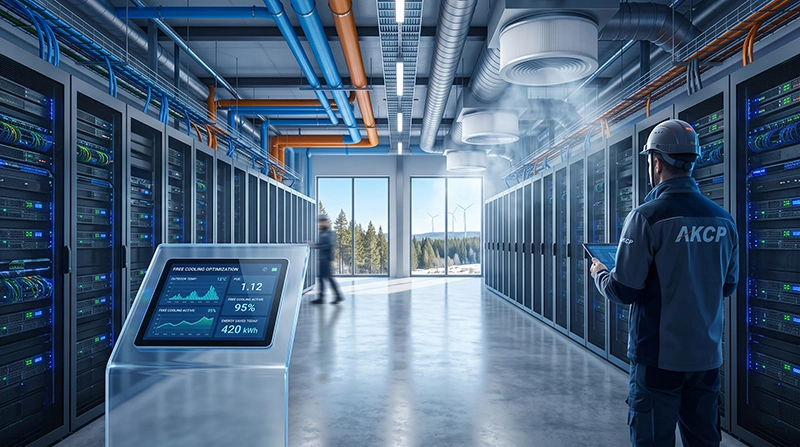
Data centers are the backbone of the modern digital economy, but they are also coming under scrutiny for their environmental impact. Both energy and water usage are gaining public and political attention. Computer systems generate massive amounts of heat, and if it cannot be dissipated efficiently, it leads to equipment overheating, performance degradation, and even total system failure. Consequently, the design of a data center’s cooling system directly impacts its reliability, operational costs, and energy efficiency.
To combat high energy costs, operators have increasingly turned to a strategy known as “free cooling.” Free cooling is an industry term for using favorable outdoor air or water conditions to reduce or avoid compressor-based refrigeration. However, the process is not literally “free,” as fans, pumps, and automated controls still consume electrical energy.
Core Technologies Driving Free Cooling
There are several methods used to capture the benefits of ambient environmental conditions:
- Air-side natural cooling: This method involves directly introducing outdoor, low-temperature air into the data center while discharging hot air outdoors.
- Heat pipes and heat exchangers: To prevent direct air mixing, indoor heat is transferred outside through plate heat exchangers or heat pipes.
- Water-side natural cooling: This approach uses dry coolers or cooling towers to supply low-temperature cooling directly to chillers.
- Evaporative cooling: This lowers air temperature by absorbing heat through water evaporation, often using a wet-film humidifier paired with a fan.
The Advantages and Disadvantages of Free Cooling
Like any engineering solution, free cooling comes with a distinct set of pros and cons that operators must balance.
Advantages:
- Massive energy savings: Cold-climate locations enable exceptional cooling efficiency with relatively simple free-cooling systems.
- Lower Power Usage Effectiveness (PUE): PUE is the standard metric for data center power consumption, defined as the ratio of total facility energy usage to IT equipment energy usage.
- Achieving peak efficiency: While the Uptime Institute reported an average data center PUE of 1.58 in 2020, facilities in cold climates using free cooling can achieve PUEs of 1.2 or lower.
- Reduction in mechanical dependency: Evaporative cooling is highly suited to arid regions and can greatly reduce the demand for traditional mechanical refrigeration.
Disadvantages:
- Climate dependency: Air cooling performs best only when outdoor conditions actively support water-side or air-side economization.
- Environmental risks: When fresh outdoor air is introduced directly, dust and humidity levels must be strictly controlled to protect sensitive IT equipment.
- Humidity constraints: Direct air cooling is less viable in damp climates, meaning high-humidity areas must rely on heat exchangers to avoid direct air mixing.
- Water consumption: Water-side cooling towers require access to water, and while dry coolers are a water-saving alternative, they are less efficient.
- Fluctuating energy use: When economizer conditions are unavailable, compressors must run longer, increasing energy use.
Industry Giants Leading the Charge: Google’s Global Fleet
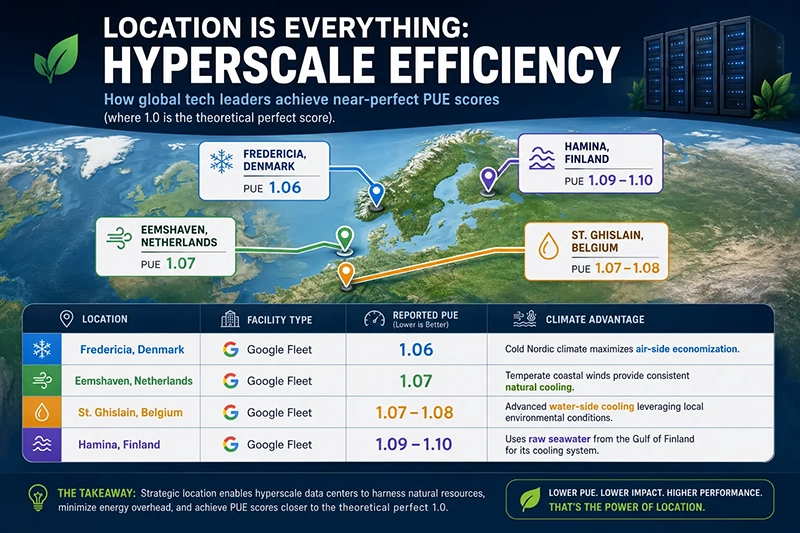
Hyperscale data center providers are strategically locating facilities in optimal climates to maximize free-cooling days. Google is a prime example of an operator leveraging environmental conditions to achieve industry-leading PUE metrics. Across its global fleet, Google maintains an exceptionally low fleet-wide trailing twelve-month PUE ranging from 1.09 to 1.11.
A look at their specific campuses reveals how location drives these efficiencies:
- Eemshaven, Netherlands: Maintains a consistently low trailing twelve-month PUE of 1.07.
- Hamina, Finland: Operates with a quarterly PUE of 1.09 to 1.10.
- Fredericia, Denmark: Reaches a quarterly PUE as low as 1.06.
- St. Ghislain, Belgium: Achieves a highly efficient PUE hovering between 1.07 and 1.08.
- United States Facilities: Locations like Council Bluffs, Iowa, and The Dalles, Oregon, achieve PUEs ranging from 1.06 to 1.14.
Beyond just geographic placement, Google has revolutionized its cooling operations using artificial intelligence. Google applied DeepMind machine learning to optimize cooling across its data centers, achieving a 40% reduction in cooling energy consumption. These results were achieved entirely through the operational optimization of existing infrastructure, relying on real-time adjustments to temperature setpoints, valve positions, and fan speeds.
The Role of Monitoring in Free Cooling
Whether you are running a hyperscale facility or an edge data center, any modern system requires monitoring and alarms. Free cooling introduces dynamic environmental variables, making real-time oversight critical. AKCP provides a comprehensive ecosystem of monitoring solutions tailored to these exact needs.
- Environmental Oversight: AKCP Monitoring Solutions provides alarms and monitoring for flow, pressure, temperature, and leak detection, with the ability to report directly into data center management software suites such as its own Quicklime DCIM software.
- Temperature Tracking: Temperature sensors measure and record the temperatures of the server surface, intake and exit coolant inside coils, and liquid baths. Thermal map sensors monitor racks front and rear, top, middle, and bottom to measure ∆T and indicate cooling efficiency.
- Power Monitoring for PUE Calculation: AKCP offers power monitoring at the aggregate PDU level or at the individual “in cabinet” level. Monitoring at the PDU level allows administrators to calculate precise PUE numbers and ensures that power loads are distributed evenly across the facility.
- Future Integrations: Data centers are increasingly utilizing digital twins to support initiatives like predictive capacity management, renewable energy integration, and free cooling utilization. AKCP Quicklime is an AI-enabled DCIM with a Digital Twin to monitor all facets of data center efficiency. Technologies such as sensorCFD allow visualization of airflow within the facility.
use the below tool to identify your data center location and the free cooling potential of your facility.
Leave a comment